
Thomas Abbott
Dealer of Sydney; died 1812.
Albemarle
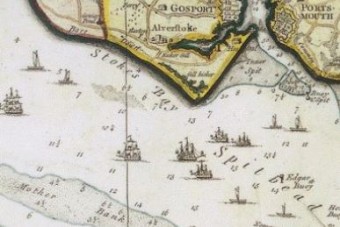
The convicts of this ship made an attempt, in conjunction with some of the seamen, to seize the ship on the 9th April, soon after she left England; and they would in all probability have succeeded, but for the activity and resolution shown by the master George Bowen, who, hearing the alarm, had just time to arm himself with a loaded blunderbuss, which he discharged at one of the mutineers, William Syney (then in the act of aiming a blow with a cutlass at the man at the wheel) and lodged its contents in his shoulder.
His companions seeing what had befallen him, instantly ran below; but the master, his officers, and some of the seamen of the ship following them, soon secured the ring leaders, Owen Lyons and William Syney. A consultation was held with the naval agent, the ship's company and the military persons on board; the result of which was, the immediate execution of those two at the fore yard arm.
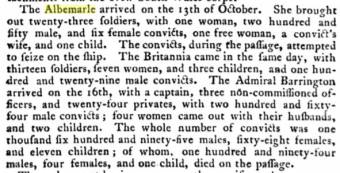
They had at this time parted company with the other transports (The Matilda, Active, Britannia and Admiral Barrington) and no other means seemed so likely to deter the convicts from any future attempt of the like nature. Two seamen who had assisted the convicts were put in irons and left at Madeira to be sent back to England. [2]
On the 9th instant, in latitude 44 30 north, longitude 15 20 west, a number of convicts were admitted upon deck early for the benefit of fresh air. In a favourite opportunity (when the principal part of the watch was aloft about the rigging) they made an attempt to take the ship from us, having previously prepared themselves overnight for that purpose. They began with knocking down the sentinels and taking their arms from them, which they easily effected, and were actually making their way aft to the cabin, the principal ringleader going to the helm with a cutlass in his hand he had just taken from one of the sentinels to cut down the helmsman and take possession of the wheel; but very fortunate for us all, I was upon deck at the time they began their insurrection, and immediately ran to the cabin for my blunderbuss, met and shot the ringleader in the right shoulder; feeling the smart of the wound, he down cutlass and run; the others seeing their principal hero flying, immediately followed his example, and flew to the prison room and forehold, and left me in possession of the deck. I then mustered all hands under arms, and sent a part below to search for those that had secreted themselves; found three of the principals; the first we got up instantly confessed the whole plot, and that the other two were the ringleaders and the original instigators of this horrid scene; upon this information, and one of them being the man I had wounded, it was unanimously thought proper for the future preservation of the ship and our lives, and to strike terror in the convicts, immediately to hang the two last at the fore-yard-arm; this had the desired effect upon the convicts on general, who immediately sent us a letter confessing all their horrid intentions, and of taking the ship to America.
We are now very peaceable and I am in hopes shall continue so during the remainder of the voyage. The Matilda parted company the first night we left Portsmouth, the Active and Britannia on the night of the 3rd, and the Admiral Barrington on the 7th in a hard gale of wind, so that we had no ship in company.
Lieutenant Robert Parry Young, who came out as Naval Agent in the Albemarle, has, I presume, informed their Lordships of the convicts having mutinied on board that ship during the passage, and the necessity he was under, of executing two of the ringleaders. From the information I have obtained of that business, Lieutenant Young appears to have conducted himself with a great deal of propriety and in a very officer-like manner, I am, etc. A. Phillip.
 [5]
[5]George Bowen, captain of the ship Albemarle, on her voyage from Bombay to London, was brought into Morlaix, being interrogated respecting what he knew of la Perouse, who sailed from France on a voyage round the world, made answer, that in December 1791 being on his return from Port Jackson to Bombay, he himself saw on the coast of New Georgia, in the eastern ocean, part of the wreck of M. de la Perouse's ship floating on the water, and that he imagines it to have belonged to a French-built ship. That he did not go ashore, but that the natives of the country came aboard his vessel. That he could not understand their language, but that he conceived from their signs some ships had visited those parts. That these people were acquainted with the use of several implements of iron, of which they were very desirous. That he, the deponent, had bartered several iron articles with these Indians for beads and bows. That, with regard to the character of these Indians, they appeared to him to be peaceable and better informed than the inhabitants of Otaheite, since they had a perfect knowledge of the implements of iron. That their canoes were made in a superior manner. That when the natives were on board his ship he did not yet know any thing of the wreck; but sailing along the coast, he perceived it about midnight, on the 30th of December 1791, by the light of a large fire which was burning on the land. That had it not been for this fire he should probably have run on the rocks of Cape Deception. The deponent further declares, that all along this part of the coast of New Georgia he observed a great number of cabins or huts. That these Indians were of a stout make and gentle disposition; whence he presumes that if M. de la Perouse, or any of his crew, were on the land, they are still living; and that he knows, of all the vessels which have navigated these seas, none but M. de Bougainville, the Alexander, the Friendship of London, M. de la Perouse, and the deponent, ever were at this place; consequently, he presumes, the wreck must have belonged to the ship of M. de la "Perouse, since the Alexander was sunk in the strait of Macassar, and the Friendship arrived safe in England. Being interrogated, whether he had seen any garments upon the natives of the country, denoting them to have had communication with Europeans, he answered that these Indians were naked, that the climate is very hot, and that he understood by their signs that they had seen ships before. That he saw in the possession of these Indians, fishing-nets, the threads of which were made of flax, and the meshes were of European workmanship. That he took a piece of one out of curiosity, from which it would be easy to judge that the materials and workmanship were European.