
Colonial Events 1801
In 1801, the colony of New South Wales was governed by Acting-Governor Philip Gidley King, who had assumed command in September 1800 following the departure of Governor John Hunter.
The total population in March 1801 was recorded as 5,515 individuals, consisting of 3,715 men, 1,047 women, and 956 children. Within this population, a nearly equal split existed between those supported by the Crown and those supporting themselves; 2,799 people were victualled from the public stores, while 2,736 were independent.
The civil department included high-ranking officials such as the Acting Lieutenant-Governor, the Deputy Judge-Advocate, a Commissary, and a Principal Surgeon. To bolster security and maintain order, the colony utilized both the New South Wales Corps and the "Loyal Association," a volunteer force with divisions in Sydney and Parramatta.
A central focus of administration in 1801 was the rigorous suppression of the spirit trade that had previously dominated the colonial economy. Governor King aggressively restricted the importation of spirits, refusing to allow several vessels to land their cargoes. To prevent monopolies and extortionate prices, which had reached as high as £8 per gallon in previous years, King mandated that all landed spirits be bonded in a secure public store. These spirits could only be released with a written permit from the Governor, and the price was strictly capped, often at 20s. per gallon. King also addressed the issue of "dealers" who bought convicts' rations with spirits, ordering that such liquor be staved to protect the prisoners from starvation.
Economic reforms were further extended through the establishment of a Government Store to break the "scandalously exorbitant" monopolies held by a few individuals. This store provided settlers with essential tools, clothing, and merchandise at a regulated profit of 30 to 50 percent above the prime cost, intended only to cover freight and risks. To facilitate internal commerce, copper coin was circulated at double its face value. Agricultural stability remained a primary concern, though it was severely hampered by "unheard-of bad weather" and devastating floods in the Hawkesbury district. These floods destroyed wheat stacks and livestock, leading to a reduction of the grain ration to two-thirds of the standard allowance in mid-1801. Despite these setbacks, the Crown's livestock herds thrived, with 880 head of cattle and 777 sheep recorded by June 1801, and King continued to distribute breeding stock to industrious settlers to promote long-term self-sufficiency.
The year 1801 was marked by significant sea and land exploration. Lieutenant James Grant in the Lady Nelson completed a survey of Bass Strait, identifying Western Port as a safe and commodious harbor. In June 1801, Grant, accompanied by Lieutenant-Colonel William Paterson and Ensign Francis Barrallier, undertook a thorough examination of the Hunter River. They discovered high-quality coal and cedar in great abundance, leading to the establishment of a small settlement at the "Coal Harbour" (Newcastle). This settlement initially consisted of a magistrate, a corporal, five privates, and sixteen convicts tasked with mining coal for government use.
Social and political tension remained high throughout 1801, particularly regarding the presence of "Irish rebels" and "Republican characters," whom King viewed as a constant threat to colonial tranquility. The administration maintained a state of suspicion, implementing strict regulations on public meetings and requiring permits for movement. Friction between the civil government and the military reached a climax in late 1801. Governor King found himself in a bitter dispute with Captain John Macarthur, whom he described as a monopolist. Following Macarthur's duel with Lieutenant-Colonel Paterson and his refusal to provide sureties for keeping the peace, King placed him under arrest and sent him to England to face trial.
Infrastructure and public welfare initiatives also progressed in 1801. Efforts were made to improve the public wharf and complete the stone pier. The Female Orphan School was actively managed, and King utilized the "Orphan Fund"—funded by spirit licenses and shipping dues—to support the institution. While the legal system was criticized for its "unfortunate mixture of civil and military duties," the courts continued to process claims, and King worked to resolve litigious disputes between debtors and creditors. By the end of 1801, the colony of New South Wales was transitioning from a purely penal outpost into a more complex settlement with expanding territorial interests and a more regulated internal economy

January
Muster (Census) taken.
February
Ticket of leave system introduced by Governor KingFebruary 21
Arrival of convict ship Anne from Cork. Hunter Valley Bushranger John Fitzgerald convict arrived on the Anne
March 2
Flood at the HawkesburyMarch
Survey of coast near Western Port by Lieutenant James Grant.
April 13
Charles Grimes appointed Acting Surveyor General of N.S.W
In 1801 Governor King was presented with a silver snuff box by Lieut. James Grant - 'The oval box is engraved with the initials 'PGK'. The underside of the lid is inscribed: 'Lt. Grant to Governor King June 4 1801'. This was probably presented on the occasion of the departure of Lieut. Grant on the famous exploratory expedition to the Hunter River on the Lady Nelson in June 1801
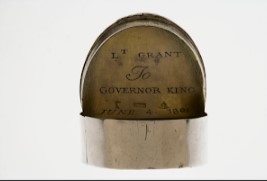 Governor King's snuff box
- National Museum of Australia
Governor King's snuff box
- National Museum of AustraliaJune 9
Memorandum to Colonel Paterson and Lieutenant Grant from Governor King regarding information to be collected at Hunter RiverThe expedition to Hunter River included Lieut-Colonel Paterson, Lieut. James Grant, J. Murray, R.N., Ensign Barralier, George Cayley and Dr. John Harris. After the Francis returned to Sydney with a small cargo of coal, artist John William Lewin joined the expedition.
June 12
Arrival of convict ship Earl Cornwallis from England under Master James Tennent master. Surgeon John DightJune 14
Lieutenant Grant and John Harris disembarked at Coal Island (Nobbys) and raised the new Union on top of the islandJune 15
Lady Nelson taken round Pirate Point to the small bay with fresh water named by Colonel Paterson Freshwater Bay.June
James Grant and Colonel Paterson examined Ash IslandJune 19
Colonel Paterson sights natives in the distance at Hunter RiverJune 22
Francis Barralier and Mr. Grant sound the entrance to the Hunter river25 June
Description of coal at Newcastle written by Lieutenant-Colonel Paterson to Governor King, 25 June 1801June 29
Colonel William Paterson, John Harris and Mr. Lewin take excursion of seven days using launch and small boat belonging to Mr. HarrisJune 30
Exploration party proceed about 14 miles up Hunter river
July 1
Colonel Paterson's party arrive at Schank's Plains (Maitland)July 9
Heavy showers at Hunter River.July
Settlement established at Coal River (Newcastle) under Corporal John Wixtead . - Early Convict Coal MinersJuly 18
Departure from Portsmouth of Matthew Flinders in the Investigator (formerly Zenophon). Under the recommendation of Sir Joseph Banks, the Investigator was said to admirably fitted out and manned with specially selected men who were distinguished by a glazed hat decorated with a globe and the name of the ship in letters of gold. (Ipswich Journal 27 June 1801).Robert Brown was appointed botanist on the Investigator by Sir Joseph Banks
William Westall was appointed landscape artist with Matthew Flinders' Investigator expedition to Australia, at a salary of 300 guineas. During the voyage he made a large number of pencil-and-wash landscapes in places visited by the Investigator and a series of coast profiles in pencil. When the Porpoise ran aground on Wreck Reef his sketches were 'wetted and partly destroyed' and, while Westall travelled in China, the drawings, regarded as part of the official record of the voyage, were taken by Lieutenant Robert Fowler to England. There, at the suggestion of Sir Joseph Banks, they were handed to Richard Westall to be 'restored to a proper state'. - Australian Dictionary of Biography

August 17
Female orphan School established in the former residence of Lieut. Kent, George St. Sydney. Formally opened on this day.
September 14
Duel between John Macarthur and Colonel William PatersonSeptember 20
Fustic had been discovered at the Hunter River. In September 1801 Governor King issued an order prohibiting any trees of that kind to be cut down without written permission of government. King sent samples to the Duke of Portland stating that although the trees were small they appeared to yield excellent dye. Samples were also sent to Sir Joseph Banks, however it was very cheap to obtain from the West Indies and it was doubted whether there was any commercial potential from the Hunter River fustic. (Fustic produced a very fine yellow dye)September
Return to England on the Hunter, of John Macarthur
October 4
Departure of Earl Cornwallis, Capt. Tennent for Bengal
November
Departure from the Colony of Lieutenant James Grant.
December
Blankets made at Parramatta gaol from locally produced wool.December 14
Arrival of the convict ship Minorca - James Hardy Vaux and surgeon William Redfern convicts on boardDecember 14
Arrival of the convict ship Canada. Master William Wilkinson. Surgeon John KellyDecember 14
Arrival of convict ship Nile. Master James Sunter. Convict Margaret Catchpole arrived on the Nile.↑