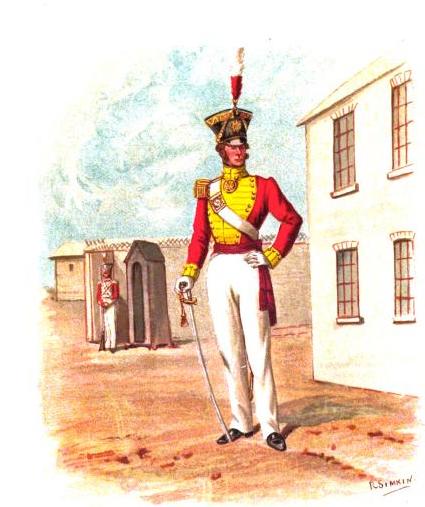
The 57th Regiment served in Australia in the years 1825 - 1832
Extract from The History of the 57th Regiment:
"The embarkation of the 57th regiment for New South Wales commenced in October 1824, and continued till November, 1825, when the last detachment sailed. After performing police duties against the Whiteboys in Ireland, the regiment had now to act as guards to the convicts being shipped to Australia, and was embarked on board a number of different vessels for this duty
The convict ships in which the service companies went out took from five to six months on the voyage, so that it was not till nearly the middle of 1826 that the whole of them reached Australia. On arrival there the headquarters, under Lieut. Colonel Shadforth - Colonel Carey having remained in England-were quartered at Sydney, where there were large, airy, well-arranged barracks, while a number of detachments of various strength were quartered at Moreton Bay, Melville Island, Norfolk Island and Hobart
These detachments were employed in a variety of ways, furnishing guards over the convicts, exploring the undiscovered tracts of country, acting as engineers, and performing many other duties connected with the development of the colony. Some of the detachments were employed in hunting bushrangers, and received a reward for each one captured.
Of the officers of the regiment engaged in exploring and surveying the country, Captain Logan, who commanded the detachment at Moreton Bay, was one of the most energetic and successful. During the year 1826, he discovered the magnificent river now known as the Darling, fifty miles north of Moreton Bay, which he named after Lieutenant-General Sir R. Darling, who had arrived at Sydney a short time previously"
Detachments were also stationed at Newcastle, Maitland and Port Stephens.
Robert Dawson mentioned the soldiers at Port Stephens in The Present state of Australia: A Description of the Country,etc and the manners, customs and condition of its aboriginal inhabitants ...Robert Dawson
Before we arrived at Soldiers Point darkness came on, and as the road over the rocks near the shore was both difficult and dangerous for our loaded pack-horses, Ben ran forward to the Point, and brought to our assistance the corporal and two soldiers of the 57th regiment, who were stationed with three others at that solitary spot, to intercept the runaway convicts, on their passage from the penal settlement of Port Macquarie to Newcastle and Sydney. Welcome to you, gentlemen, was the salute of the corporal as he approached us. And welcome too was the corporal, for we should have found it difficult to reach the station in the dark with the pack-horses without his assistance.
The Asia departed Cove of Cork 29th October 1824 and arrived at Port Jackson 22 February 1825.
The guard embarked on 12th October 1824. This was the first detachment of the 57th regiment and consisted of Captain Richard Heaviside, Lieut. J. G. Le Merchant, Serjeants William Gosling and Edward Mollowney, Corporal Thomas Mollowney and 30 Privates including Thomas Allen, James Blacklock, John Bridger, William Chambers, Henry Chalkling, William Collison, John Coppard, Thomas Crowe, Timothy Daly, Robert Eagan, John Flanagan, John Hicks, Robert Jennings, William Johnstone, James Jones, Archibald McDermott, John McDonnell, Peter Mahoney, William Morris, James Neile, John Pollard, Joseph Poole, Michael Ready, James Rooney, Richard Ryan, Denis Salmon, William Taylor, Samuel Wellbank, John Walsh, William Rice. (Records of the 57th regiment - Trove)
Surgeon-superintendent James Mercer.
Soldiers of the 57th treatment by the surgeon included:
Private Robert Eagen, age 37. Treated for venereal disease while still in the Cove of Cork
Private William Collison, age 24. Venereal disease
The Guard embarked on 12 October 1824 and consisted of Lieut-Governor Colonel Stewart of the 3rd regiment, Lieut. Thomas Bainbridge of the 57th and 54 men of the 57th and 3rd (Buffs) regiments in including Sergeant Pike and Private John Finn.
The Asia departed London 23 November 1827 and arrived in Port Jackson 13th March 1828.
The guard comprised a detachment of the 57th Regt., with 7 men of the Royal Veterans and 5 women and 6 children under the orders of Lieutenant George Edwards. Members of the guard who were mentioned in the surgeon's journal include Lieut. Edwards (cholera); Patrick Coade (phthisis); William Dockeral (pneumonia); John Digney (cholera); John McMahon (dysentery); Thomas Quinn (pneumonia).
George Edwards was born in Hastings, Sussex, England on the 2nd February, 1795. He joined the British Army at the age of 24 as an Ensign. He was promoted to Lieutenant in 1828 and was appointed to the settlement at Moreton Bay in that same year. He was there at the time of the murder of Captain Patrick Logan. It was he who informed the Commander of the 57th regiment of the tragic death of Patrick Logan
The Borodino departed Cork 11 February 1828 and arrived at Port Jackson 14 July 1828.
The Guard consisted of Captain Philip Aubin and Ensign Aubin of the 57th regiment, 48 men of the 57th and two of the Royal Veterans.
Major Phillip Aubin served in the Peninsula from Nov. 1811 to the end of the war, including the battles of Vittoria, the Pyrenees, 25th 28th 30th and 31st July; Nivelle, Nive, 9th 11th and 13th Dec 1813; besides many other minor actions and skirmishes. Severely wounded through the left side in action at Coucher 18 March 1814. Served subsequently in the American war - Army List 1841
The Bussorah Merchant departed London 27th March 1828 and arrived Port Jackson 26 July 1828.
On board the military guard consisted of one man of the 57th regiment and 30 of the 39th commanded by Captain Burton Daveney of the 57th regiment and Ensign W. Kennedy Child of the 39th.
Major-General Burton Daveney - *November 24th 1872 Died at his residence, Heigham Grove, Norwich, aged 73, Major-General Burton Daveney, formerly of the Royal Scots Regiment. He was born at Colton, in December, 1799, and obtained his commission as ensign in the 57th Regiment. In 1825 he went to Australia as lieutenant in command of a detachment which had charge of nearly 200 convicts. On the voyage small-pox broke out, and the vessel was placed in quarantine. The young lieutenant throughout a period of the greatest difficulty discharged his duties with conspicuous success. In 1830 he exchanged into the 1st Royals (afterwards the Royal Scots), and served in one or other of the battalions of that regiment for thirty-one years.....Norfolk Chronicle
Henry Porcher departed Ireland 5 August 1825 and arrived Port Jackson 3 December 1825.
The Guard embarked on the ship on 28th June 1828 and consisted of a detachment of 33 men of the 57th regt., under orders of Captain Vance Young Donaldson.
Vance Young Donaldson was appointed Ensign 14 September 1804, Lieutenant 25 December 1805, Captain 24 June 1813 and Brev. Major 10 January 1837. He served in the Peninsula from June 1809 to the end of the war, including the siege of Badajoz in April 1811; battles of Albuera, Vittoria and the Pyrenees. He was appointed Commandant at Norfolk Island in 1826
The Hooghley departed Cork 5th January 1825 and arrived Port Jackson 22 August 1825.
The ill-fated Captain Patrick Logan was in command of the Guard which consisted of 35 men of the 57th regiment and Ensign Taylor. The Guard embarked in England on the 13th November. Several were ill with catarrhal complaints that arose from being cold on the march from Chatham to Deptford. Many of the soldiers are mentioned in the surgeon's journal including the following:
Private James Barns age 30
Private Raby Perch age 32
Private George Carpenter age 29
Sergeant Curry age 31
Private John Mills age 33
Private D. O'Keefe
Private Bryan Conboy age 25
George Williams age 37
John Doherty, Drummer age 19
Private John Norman age 30
Private James Shanahan age 26
Private Thomas Keay (boy) age 15
Private Blake Dowling age 30
Private James Riordan age 20
Private Daniel McNamara age 20
Private Francis McCarthy age 19
Private James Mooney age 20
Private Cornelius Flinn age 30
The Mangles departed Cork 23 October 1825 and arrived at Port Jackson 18 February 1826
The guard embarked on 8th September 1825 and consisted of a detachment of 33 men the 57th regiment under the orders of Lieutenant-Colonel Shadforth and Ensign Shadforth
Soldiers mentioned in the Surgeon's journal included:
Private Patrick Magee
Private Walter Jervis age 25 sent to the military hospital, Dublin
Private Thomas Bowden age 21
Private William Morgan age 25 sent to the military hospital, Dublin
Private Edward Carney age 24
Private Henry Holgate age 18
Private James McCarty age 21
Minstrel departed London 10th April 1825 and arrived at Port Jackson 22 August 1825.
The Guard embarked on 18th March 1825 and consisted of a detachment of the 57th regiment under orders of Lieutenant Henry John Tudor Shadforth. Lieutenant Shadforth was the eldest son of Lieutenant Colonel Thomas Shadforth who arrived on the Mangles in 1826.
The Morley departed Dublin 3 November 1827 and arrived at Port Jackson 3rd March 1828.
The Guard comprised a detachment of 57th regiment under orders of Captain Robert Hunt and Ensign Alexander together with 6 women and 6 children belonging to the troops. They embarked in England on the 27th September 1827.
Robert Hunt was appointed Ensign 25th January 1798; Lieutenant on 6th November 1799; Captain 11th May 1809; Brevet Major on 22 July 1830 and Major in December 1830. He was appointed Commandant at Norfolk Island in November 1828.
The Norfolk departed Portsmouth 17 April 1825 and arrived at Port Jackson 18 August 1825.
The Guard embarked on 12 March 1825 and consisted of a
detachment of the 57th regiment under orders of Captain James Brown.
James Brown was appointed Captain in the 57th regiment on 17 January 1822. He married Ann Lockyer daughter of Major Edmund Lockyer in January 1827 and sailed for Madras with his regiment in 1831. Ann Lockyer Brown and their four children died tragically in 1833
The Prince Regent departed London 11th June 1827 and arrived Port Jackson 27 September 1827.
The Guard comprised a detachment of 29 men 57th regiment under orders of Lieut. Campbell. Passenger Ensign Charles Henry Darling of 57th regiment, nephew to His Excellency, Governor Darling and later Governor of Victoria. He was about 18 years of age in 1827.
The Royal Charlotte departed Portsmouth 5 January 1825 and arrived at Port Jackson 29 April 1825.
The Guard embarked on 3rd November 1824 and consisted of Major Edmund Lockyer and 34 men of the 57th regiment, Mrs. Lockyer and family of ten children. Threatened mutiny during the voyage
The Sesostris departed Portsmouth 30 November 1825 and arrived at Port Jackson 21 March 1826.
A detachment of the 57th Regiment embarked on the Sesostris on 4th November 1825 at Portsmouth. They were under the orders of Major John Campbell and Ensign Benson.
Some of the soldier's mentioned in the surgeon's journal included: Private W. Warren, Private G. Farnham, Private Samuel Fairman, Private Mark Lane, Private E. Jennings, Private J. Steadman, Private S. Hardcastle, Private D. Mitchell, Private R. Stevenson, J. Grant. The wife of Private Hynes gave birth to a daughter in the ship hospital which had been divided off from the sick men as the soldier's berth was even more crowded. The Band of the 57th joined its Corps by the Sesostris.
Sir Charles Forbes 1825 departed Portsmouth 5 January 1825 and arrived VDL 18 April 1825.
The guard embarked on 5th November 1824 and comprised a detachment of 30 rank and file of the 57th regiment. Officers Grey and Ensign Gore of the same regiment.
The Sir Godfrey Webster departed Cork 11th July 1825 and arrived Sydney Cove 3 January1826.
The ship was still being fitted out at Deptford when the soldiers of the guard arrived on 24 May 1825. Several became ill with catarrh and pneumonia because the barrack room became damp and fires could not be lit in consequence of the trades people not having finished their work between decks. Soldiers treated by the surgeon at this time included Alexander Lough, William Welch, Thomas Sweeney, Patrick Goggins and William Pearce.
The Guard consisted of a detachment of the 57th regiment comprising two commissioned officers, 33 rank and file, 6 women and 7 children under orders of Lieutenants John Ovens and James Doyle. Dr. Doyle of the 57th regiment came as passenger.
The Woodford (2) departed Portsmouth 2 May 1828 and arrived VDL 25 August 1828
The guard consisted of detachments of the 57th and 39th regiments under the command of Lieut. Frazer of the 26th reg., who was on his way to join his regiment in India
Surgeon-superintendent William Petrie kept a medical journal from 29th March to 31st August 1828.
Woodman (2) 1826
The Woodman departed Cork and arrived in VDL 7 June 1826.
The guard consisted of Captain Joseph Wakefield, Ensign John Long Innes, Serjeant John Hale and 20 rank and file of the 39th and 2 sergeants and 17 rank and file of the 57th regiment
Surgeons-superintendent John Rodmell and Cornelius Kelly
Cornelius Kelly took over the duties of Surgeon Superintendent on the convict ship Woodman at the Cape of Good Hope when the surgeon of the ship John Rodmell died during the voyage.
Soldiers mentioned in the Cornelius Kelly's medical journal include:
Private George Tingey
Private Charles Beck
Private Joseph Mercer
Private James Tomlin
Private John Harbour
Private John Murphy
Seizure of the Wellington
"A very unpleasant adventure befell a party of the 57th regiment (a Sergeant Brown and thirteen men), who had embarked at Sydney in charge of a number of convicts for Norfolk Island, taking with them also the clothing for H company, who were quartered there.
When a few days out from Sydney, the sergeant
having neglected his instructions and allowed the whole of the convicts to come on deck together, the latter overpowered the sentry, made the whole of the soldiers and the captain of the ship prisoners, and obtaining possession of the arms of the former, and H company's clothing, dressed themselves up in the latter and threw their own overboard.
They were at first fully determined to murder the soldiers, but fortunately two of the 57th men, who were natives of Belfast, had discovered among the convicts three of their fellow townsmen, and during the voyage shown them some slight acts of kindness. This saved the whole party, as the men in question persuaded the remainder of the convicts to spare their lives, and it was agreed, instead of killing them, to put them ashore on the first desert land sighted" [1]
Information on this page is derived from :
[1] History of the Fifty-Seventh (West Middlesex) Regiment of Foot 1755 - 1881, Compiled from Official and Other Sources by H. H. Woollright, Captain D.C.O. Middlesex Regiment, 1893, p. 223