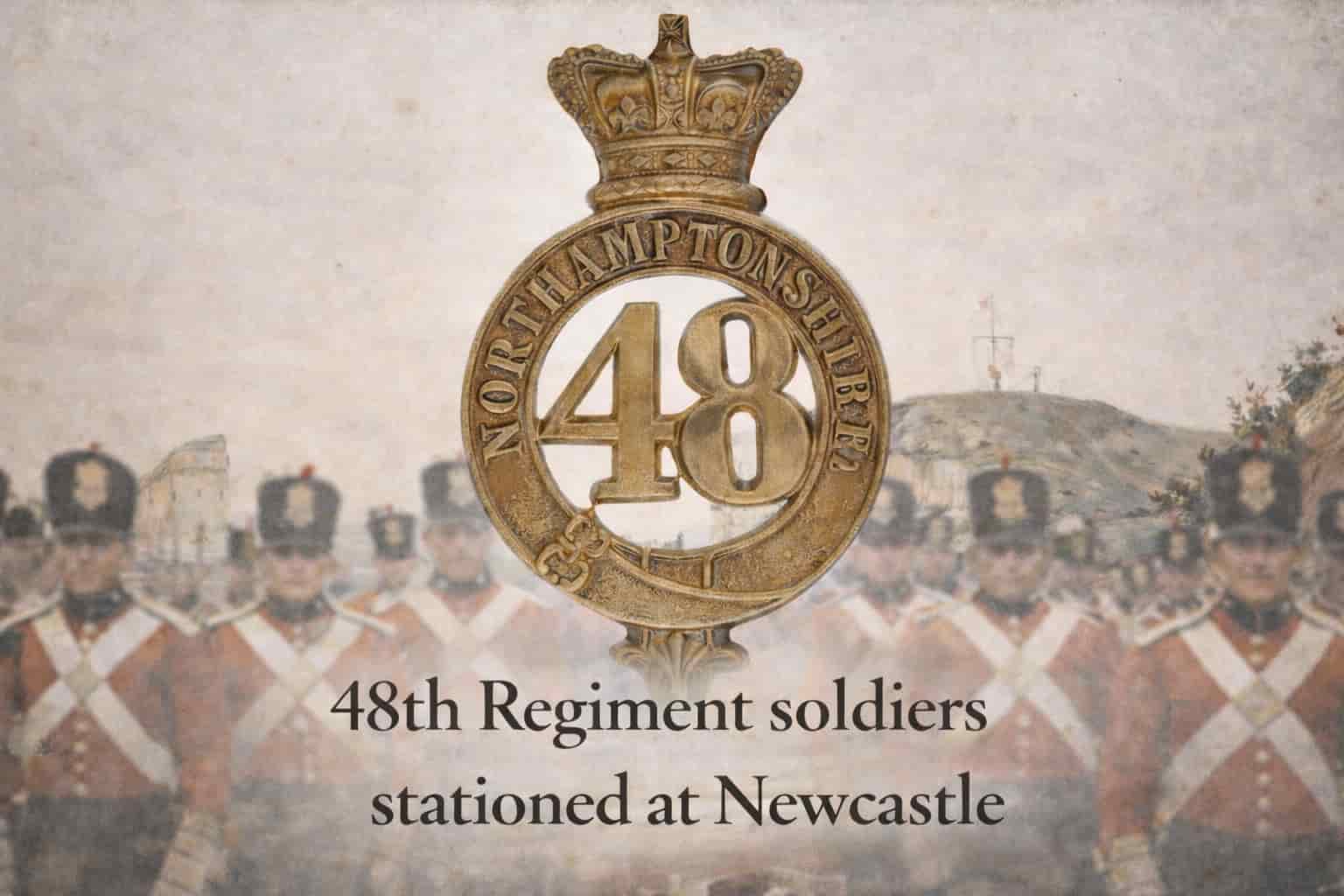
The 48th (Northamptonshire) Regiment of Foot replaced the 46th Regiment of Foot in Australia
On March 22, 1817, the main contingent of the 48th Regiment of foot under commanding officer Lieutenant-Colonel James Erskine, C.B., embarked from Cork on the ship Matilda
The voyage of the Matilda, described in the story of Mary Ann Wellington, highlights the challenges of travelling in a small sailing vessel to Australia - a journey that took six long months.
Mary Ann Wellington was born 18 April 1789, the daughter of Private George Wellington of the Royal Artillery then stationed in Gibraltar. She met her future husband Thomas Hewitt, a clarinet player in the regimental band of the 48th Regiment of Foot there, and married him on the 15 December 1805. For nearly four decades she travelled as part of the regiment through the Napoleonic Wars and later to Australia. She lived in Norwich from 1845 onwards and was reduced to poverty as a widow when her biography was written by the Reverend Richard Cobbald to raise money for her. It is now a useful social history of the life of the Regiment from 1797 to 1844. - Northampton Museum and Art Gallery
From the 'History of The Northamptonshire Regiment 1741 – 1934'
Colonel Erskine proved to be an excellent leader, maintaining the morale of his officers and men throughout the arduous trip. A man of intelligence and a lover of literature, he actively encouraged the study of letters among his subordinates, easing the monotony of life at sea. Yet, Erskine was also a strict disciplinarian, ensuring that military routines like musters and deck duties were carried out as diligently aboard the Matilda as the ship’s captain enforced nautical duties like weighing anchor and keeping watch.
The Matilda carried over two hundred privates, along with officers, their families, and the ship’s crew - all living within the ship’s cramped quarters. Managing such a large and diverse group for six months demanded both strategic skill and careful leadership. Officers like Erskine, who seized the opportunity to educate and uplift their men during this time, earned great respect.
Colonel Erskine was particularly skilled at introducing varied and engaging routines. Musters were held early, exercises were regular but not burdensome, and he devoted specific times for the regimental band to practice, taking personal interest in its progress. Weather permitting, the entire company was encouraged to walk on deck. He also promoted both intellectual and practical pursuits, transforming the Matilda into a "floating school," where soldiers honed skills that would later prove invaluable
On October 14, 1823, the remaining companies at headquarters were inspected by His Excellency Major-General Sir Thomas Brisbane, K.C.B., who issued high praise: "The Major-General is highly gratified with today's inspection of the 48th Regiment. He finds himself unable to single out any one manoeuvre for special praise, as every aspect, particularly the levelling and firing, was executed with outstanding precision. The regiment’s excellence extends beyond the parade ground to its internal organization and conduct in quarters. As this may be the last time he inspects the 48th, the Major-General regards the regiment as a model for any corps arriving in New South Wales, and conveys his best wishes." After seven years of service in Australia, the 48th Regiment was ordered to depart for its first tour of duty in India. History of The Northamptonshire Regiment 1741 – 1934 by Lieu.-Colonel Russell Gurney, Aldershot: Gale & Polden Ltd. 1935
During their military service in Australia, 1817 - 1824, the 48th regiment were stationed at Hobart, Port Dalrymple, Bathurst, Newcastle, Port Macquarie, Cox's River and Liverpool.
At Newcastle in 1823 there were stationed 1 captain; 2 lieutenants; 1 ensign 5 serjeants; 2 corporals; 1 drummer; and 85 privates ( Australasian Pocket Almanack for 1823)
The 48th Regiment were relieved by the 3rd Regiment (Buffs) and departed the colony bound for Madras or England on the following ships:
Convict ship Baring departed the Downs 27 January 1819 and arrived Port Jackson 14 June 1819.
The Military Guard consisted of Captain Charles Coates of the 89th regiment, in Command of the 48th regiment, and Ensign William Grove White of the 48th regiment
Surgeon-superintendent David Reid kept a Medical Journal between 31 October 1818 and July 1820
Henry Barber, soldier age 23, was the only member of the guard mentioned in the surgeon's journal. He was treated for jaundice during the voyage
Convict ship Caledonia departed Portsmouth 10 July 1820. Arrived Hobart 17 November 1820.
The military party consisted of thirty-three non-commissioned officers and privates of the 48th regiment, under orders of Brevet-Major Wheatstone of the 53rd regt, whose wife and family accompanied him
H.M.S. Dick departed Cork 3rd April 1817 and arrived in Port Jackson 3rd September 1817.
The guard included:
Major Gilbert Cimitiere embarked at Cove of Cork
Captain George Mackay - died 2 December 1823 age 37
Lieut. Thomas Valentine Blomfield
Lieut. Thomas W. Weston
Ensign J. Haggerstone
Ensign Hamilton
Quarter Master Joshua Stubbs and son William Travis Stubbs
Serjeant Lewis Campbell - school master
Serjeant Robert Armstrong - married to Mary Cable; was Superintendent of Light House at South Head and Superintendent of Prisoners Barracks at Parramatta (CSI)
Dorothy departed England 5th May 1820 and arrived at Port Jackson 19th September 1820.
The Military guard consisted of a detachment of 48th regiment under command of Lieutenant Holdsworth of the 82nd regiment. Lieutenant Holdsworth and family were en route to Mauritius to join his regiment
Surgeon-superintendent Robert Espie kept a Medical Journal from 1 March to 29 September 1820
Earl St. Vincent departed England 13th April 1820 and arrived Port Jackson 16 August 1820
The Guard embarked on 9th March 120 and consisted of 31 men of the 48th regiment commanded by Captain Snow of the 67th regiment. Five women and five children were also embarked on the 9 March 1820. Captain Snow's wife and children also accompanied him.
Surgeon-superintendent Patrick Hill kept a Medical Journal from 20 February to 23 August 1820. Soldiers mentioned in his journal included:
Private Matthew Tyne
Private Thomas Kemp - leg scalded with hot water
Private George Calcat - diarrhoea
Private Michael Martin - diarrhoea
Private Henry Fuss - headache
Private Henry Hopcroft - fever
The Globe departed Portsmouth on 9th September 1818, sailed via Madeira and arrived in Port Jackson on 8 January 1819.
Governor Macquarie recorded in his journal - Saturday 9. Jany. 1819 Early this morning the Ship Globe Commanded by Capt. Blyth, anchored in Sydney Cove, with 140 Male Convicts from England, from whence she sailed on the 9th. of the month of Septr. last; Mr. Clayton R. Navy being Surgeon Supdt., and Lieut. OBrien 48th. Regt. Commanding. the Guard consisting of 30 men of the 17th. and 34th. Regiments
The guard and their families were disembarked on 29 January 1819. Members of the guard mentioned in the surgeon's journal include: Mrs. Hermitage, soldier's wife, Corporal Murphy, Edward Fitzgerald, Thomas Quinn, Mrs. Edwards, Thomas McKearnan, Edward Donovan, Andrew Barron, and William Glover.
Surgeon-superintendent George Clayton kept a Medical Journal from 28 August 1818 to 30 January 1819.
Guildford departed Cork 14 November 1817 and arrived Rio 30th December where they remained 7 days. Arrived Port Jackson 1st April 1818.
The Military Guard of 35 men of the 48th regt., was Commanded by Lieut. Edward Vincent of the 48th.
Surgeon Archibald Hume joined the Guildford at Deptford on 6th August 1817. He kept a Medical Journal from 9th September 1817 to 10 April 1818. The first of members of the guard embarked at Deptford on 26th August, being 1 officer and wife, 2 serjeants, 3 corporals and 30 privates with 10 women and 9 children. On 9th September they sailed from Deptford and anchored at Gravesend and anchored in the Downs 13th September and reached Cove of Cork 17th September 1817
The surgeon's first patient was a soldier's child, John McClaverty on 26th August 1817. The child was only two years old and had suffered from a bad cough for the past year. 'The poor little fellow', wrote the surgeon, 'is not larger than a child of six months and tho' so young has all the anxiety painted in his countenance of a patient of 20 years'. The surgeon treated the child kindly however it died on 17th September at Cove.
Private William Perkins was the next patient treated for herpes zoster on 17th September 1817 while the vessel lay at Gravesend and also later while at sea
Private William Mayberry for headache and debility
Private James Johns for headache
Private Jams Flannagan age 35 for Ophthalmia
Private Andrew Malvina age 32 - this man, his wife and a little daughter about 5 years of age were all seized with ophthalmia
Private John Craig age 28 - headache
Private John Wood - griping pains, nausea
Private Philip O'dell age 22 - pain in the stomach, debility and later injured in a fall down the hatchway
Hadlow departed Cove of Cork 2nd April 1820 with 148 male prisoners and arrived at Port Jackson 5th August 1820
Surgeon-superintendent William Price kept a Medical Journal from 20th February 1820 to 15th August 1820
From the surgeon's journal.....On 23rd February the ship anchored at Gravesend where the Guard, consisting of 1 serjeant and 32 privates commanded by Captain Patrick McDougall of the 48th regiment, were embarked.
23 February 1820 at Gravesend. Five privates of the 48th Regiment forming part of the Guard were admitted into the Sick List for gonorrhoea, and one of the soldier's wives for a violent inflammation and swelling of her left eye and face. This unfortunate family (Mrs Bonnington) was delivered of a child on their route from Canterbury to Deptford. They stayed the night at Chatham and mounted the Baggage Waggon the second morning with her infant which died the third day.
9 March 1820 at Cove: At noon a military court martial assembled on board to try Patrick McDermott, private of the 48th Regiment for desertion also George White and Pat Quin sentinels for aiding and assisting in his escape.
17 March 1820: At 10am the sentence of the court martial was read to three prisoners each to receive 300 lashes on the back which was inflicted in the following manner, Pat McDermott, 150; Pat Quin, 200; George White, 100
21 March 1820: Some of the guards have been under my care for an eruption on their skins. The backs of the men that were punished are doing well.
30 March 1820: Discharged six of the ulcer cases from the sick list and the three Guards that were punished, to their duty which reduced the number of sick to 8, excluding one case of venereal of the Guards, all doing well.
Hebe departed England on 31st July 1820, touched at Rio de Janeiro and remained there 10 days and arrived at Van Diemen's Land on 31st December 1820 on their way to Port Jackson where they arrived Sunday 31 December 1820
The Guard consisted of 1 serjeant and 30 rank and file of the 48th regiment commanded by Lieut. Campbell of the 59th regiment
Isabella departed England 3rd April 1818 and arrived Port Jackson 14 September 1818
Surgeon John William Hallion kept a Journal from 1st March 1818 to 22 September 1818
The Military guard consisted of a detachment of the 48th regiment., under orders of Lieut. William Reed. Passengers William Minchin Esq. late Capt. in the 102nd Regt., with his Family arrived on the Isabella as a Free Settler to reside in the Colony
In April the surgeon remarked - In consequence of a Court-martial held on board yesterday on two Privates of the Guard, one for disobedience of orders and insolent language to his Commanding Officer, and the other for sleeping on his post, the former, Thomas Moran, this day received 50 lashes.
On 13th April soldiers Edward Burns and Henry David were handcuffed and put in irons for mutinous conduct in opposing and insulting the Serjeant of the Guard in the execution of his duty, their conduct on deck was highly mutinous, improper and subversive of all discipline and subordination. They were released and returned to duty on 4th May
21st April Samuel Perkins of the guard was discharged from Duty, flogged on the breach by the guard and appointed their sweeper
There were rumours of a conspiracy to mutiny on the voyage and tensions were high. One of the convicts Archibald Macquarie was shot by soldier Robert Hookes of the 69th regt., who was detained in gaol on arrival. Archibald Macquarie lost his leg but was not killed. An investigation into the affair was later conducted by a Bench of Magistrates and Hookes was exonerated
The military guard consisted of a detachment of 34th, 46th and 48th regiments under orders of Lieut. Thomas Henry Brotheridge of the 48th and Ensign Lax of 34th.
Captain Thomas Brotheridge married Maria Johnston, daughter of George Johnston of Annandale in 1824. Maria Brotheridge died in childbirth in Port Louis, Mauritius on 25th January 1827, their son George Thomas age 2, died in June 1827 and Captain Brotheridge died in October 1827 at Annandale
Lady Ridley departed Portsmouth 14 January 1821 and arrived Hobart 27th June 1821
The guard consisted of 27 soldiers, all but three were recruits
Surgeon James Wilson kept a medical journal from 17th November 1821 to 26th July 1821
Lieutenant John Marshall of the 48th Regiment was officer of the guard.
Lieutenant John Marshall was granted two years leave in March 1819 and was on the list of troops and passengers proceeding to England per Shipley in March 1819. Mrs. Mary Worsley, wife of a soldier of the 48th Regiment also returned to England by this ship
Soldiers mentioned in the surgeon's journal included:
Larkins departed Portsmouth 20 July 1817 and arrived Port Jackson 22 November 1817.
Surgeon-superintendent William McDonald kept journal from 7th June 1817 to 2 December 1817
The guard comprising detachments from the 46th and 48th regiment, being 40 rank and file with a Captain to command them, embarked on 28th June. Captain John Brabyn of the Royal Veterans Commander of the Guard was on a return voyage to the colony. He embarked on 19th June. The soldiers were accompanied by nine women and nine children.
The surgeon reported - treated Henry Collins of the guard for scarlet fever in August. 5 August 1817; In consequence of having detected psora among some of the guard; had a general muster of them, their wives, and children, when 17 men, one woman and two children appeared to have it with various shades of inveteracy. They were all subjected to frictions of ointment composed of sulphur vivum. Folio 9: 6 August 1817; John Smith, convict, and Joseph Slater, guard, both afflicted with secondary symptoms of syphilis.
The names of the guard on the Larkins are included in the Colonial Secretary's Correspondence - 48th regiment -
Sergeant Joseph Burrows,
Corporal Hezekiah Riely,
Corporal Henry Singleton,
Privates Owen Green,
William Ryan,
Edward Helvire,
Thomas McDonald,
Peter Dilworth,
James Stafford,
Levi Taylor,
Bryan McDermott,
Daniel Slater,
Martin Golding,
James Humphries,
Thomas Costelow,
John Fraser,
Edward Kenny
and from Pay Lists :
Private Thomas Costellow Private John Fraser Private Peter Dilsworth Private Edward Henry Private James Humphries Private Edward Melvin. Private Thomas McDonald Private William Ryan Private Daniel Slater Private James Stafford, Levi Taylor
H.M.S. Lloyds 1817
H.M.S. Lloyds, military transport, departed Cove of Cork 28th March and arrived at Port Jackson 30 August, 1817 under command of Brevet Major Thomas Bell with 200 soldiers of the 48th regiment
Major Thomas Bell - in 1818 was sent to Hobart in the Lady Castlereagh to command the military garrison there and was appointed a justice of the peace, engineer and inspector of public works
Van Diemen’s Land became a harsher penal colony, receiving the most hardened convicts from mainland Australia. A detachment from Major Bell’s company, led by Lieutenant John Cuthbertson, established a settlement at the infamous Macquarie Harbour, housing the worst criminals in the colony. Cuthbertson served commendably as Commandant and Magistrate. A veteran of eighteen engagements and seriously wounded multiple times, he enforced strict discipline. In February 1824, after rescuing a small vessel built at the harbor, Cuthbertson’s boat capsized on the return journey; despite efforts to save him, he perished, urging his rescuer to save himself instead. - History of The Northamptonshire Regiment 1741 – 1934 by Lieu.-Colonel Russell Gurney, Aldershot: Gale & Polden Ltd. 1935
Other soldiers on this voyage :
Captain William Newell Watkins
Lieutenant George Wilson Leroux VDL
Lieut. H. E. Robinson
Lieut. Charles Harry Roberts
Lieut. John Wild, Adjutant
Lieut. William Grove White
Private John Boardman
Mangles departed Falmouth 11 April 1820 and arrived Port Jackson 7 August 1820.
Surgeon-superintendent Matthew Anderson kept a journal from 17th February to 15th August 1820 .....
"On the 5th March 1820 - The soldiers embarked on board this ship are a detachment of the 48th Regiment and lately marched from Chatham to this place. They are to act as a Guard over Male convicts, about to be embarked for conveyance to New South Wales. Lieut. Matthews of the 59th regiment., commanded the guard of 30 Privates of the 48th together with another 10 wives and children of the regiment."
Michael Bone, age 19, a Private of the 48th was the first mentioned in Matthew Anderson's Medical Journal. He was treated on the day the detachment was embarked for catarrhal and fever.
John Adlington of the 48th was treated on 16th March while the ship lay at Sheerness. On 24th March the surgeon inspected the soldiers and found fourteen men were affected with the itch which he attributed to a 'common woman who came on board while the ship was still at Deptford'.
Richard Peel of the 48th received the surgeon's attention for fever
Maria departed England 10 August 1820 and arrived in Van Diemen's Land December 1820
The military guard consisted of a detachment of the 48th regiment, commanded by Lieut. John Croker of that regiment; Lieut. Gordon of the 48th, being also on board, was proceeding to join his Regiment at Sydney
Surgeon-superintendent William Hamilton kept a journal from 16th June 1820 when he joined the ship at Deptford to 6th December 1820 in Hobart
On 4 July 1820 the surgeon remarked: Guard embarked consisting of 2 lieutenants, two non-commissioned officers and thirty privates belonging to the 48th Regiment having with them 5 women and one child.
Matilda 1817
The barque Matilda sailed from Cork 28th March 1817; made Madeira 9th April; was at Rio from 17th May until 26th May and arrived in Port Jackson 3rd August 1817.
There were thirteen officers, 179 rank and file and 50 women and children of the 48th regiment on board. The wife of Serjeant Major Scully died before the ship reached Rio and three children of others soldiers also died on the passage
48th regiment soldiers on board included :
Colonel James Erskine
Major George Druitt
Major James T. Morisset
Brevet-Major James Taylor
Captain William Parry Jones; Also William Parry Yale
Lieut. John Marshall
Lieut. Edward Charles Close
Lieut. Charles J. Vandermeulon
Ensign William Kenworthy
Ensign Lachlan McAllister
Ensign Edward King. Ensign, 48th Regiment; Acting Engineer, Newcastle; Barrack Master, New South Wales from 1 April 1824.
George Alexander Stephenson, Surgeon
Private William Sutherall Private Robert Gordon
James Cracknell
John Waddington
Minerva departed Ireland 1st January 1818 and arrived Port Jackson 30 April / 1st May 1818.
Surgeon-superintendent James Hunter kept a Journal from 5th September 1817 to 8th May 1818
The guard consisted of a detachment of the 48th regiment commanded by Captain Francis Allman. Abraham Fenton came on the Minerva as Assistant Surgeon of the 48th Regiment.
Other members of the 48th regt., who were mentioned in the surgeon's journal included Private Matthew Caroline taken ill while still at Cork
Private William Cullen injured when a boat fell from the booms and crushed his body; sent 3 October 1817 to military hospital Cove of Cork.
Private William Longshaw - severely bruised in one thigh and various other parts of the body by the same accident as the case above; sent 3 October 1817 to military hospital Cove of Cork.
Sarah Mulligan together with five others from 48th regiment; severely wound in the head by the same accident as two cases above
Pilot departed Cork in 9th March 1817. Arrived Port Jackson 29th July 1817.
The Caledonian Mercury reported in February 1817 that several transport ships were assembled at Cork and were to convey the 48th regiment to New South Wales to relieve the 46th. They were to sail in company of convict ships for the same destination. [1] The military guard consisted of a serjeant and 30 privates of the 46th and 48th regiments under the orders of Lieutenant Franklin of the 69th regiment.
Prince Regent departed Deal 11th October 1819 and arrived Port Jackson 27th January 1820.
Surgeon-superintendent James Hunter kept a Journal from 1 September 1819 to 28 February 1820
William Brandford - treated by the surgeon for an ulcer
William Pewtrell - treated by the surgeon for a bruise
James Bowles - treated for rheumatism
Thomas Hughes treated for dysentery
William McGeary treated for rheumatism
Three of the soldier's wives were mentioned in the surgeon's journal:
Letty Stewart came on board in a very weak and debilitated state, having lately had a child. The surgeon gave her wine and preserved meats and she gradually recovered by November
Harriet Gordon had been in a bad state of health a long time and continued in a weakly state all the voyage necessitating the surgeon to supply her with medicine and occasional wine as well as a nutritious diet
The wife of Thomas Hughes of the 48th regiment was delivered of a daughter on the morning of 14th December.
Governor Lachlan Macquarie recorded the arrival of the Prince Regent in his Journal - the Guard consisted of 31 Soldiers of the 48th Regiment commanded by Cornet M.C. Chambers of the 21st. Light Dragoons. The Convicts and Guard arrived in good Health - none of either having died on the Passage out. LEMA