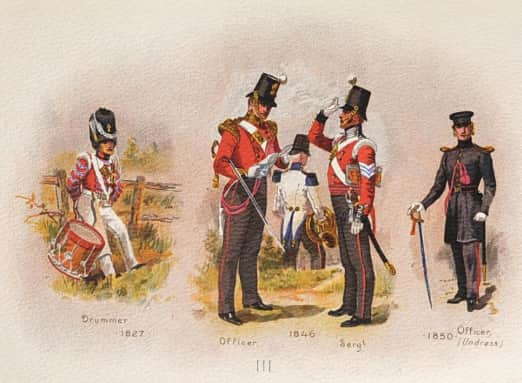
In October 1828 the 21st Foot moved from Bath to Fermoy, Ireland. In June 1829 it was at Mullingar and in 1830 in Kilkenny. In September 1831 the regiment moved from Dublin to Warrington, Lancashire.
Between the years 1832 and 1833, the 21st were sent to Australia in detachments embarking as guards in charge of convicts on ships bound to the colonies.
The Regiment was afterwards stationed in Tasmania, with detachments in Perth and Swan River in Western Australia until 1839, when it proceeded to the East Indies.
They were given a fine farewell by Lieut-Governor Sir John Franklin on their departure from the colony:
The embarkation of the 21st R. S. Fusileers for India, took place at seven o'clock on Monday morning. To the honor of that fine Corps when the Parade was formed, there was not one man absent nor one man drunk. The warm estimation in which the Regiment was held by all classes here, induced a large assemblage to witness its departure.
When Major George Deare appeared on the Parade he was received with three hearty cheers.
After a short delay the regiment quitted the Hobart Town Barrack, most probably for ever. As it proceeded down Macquarie-street three cheers were given at Government-house, and soon afterwards Sir John Franklin placed himself at their head, and on reaching the Wharf he addressed them in a short but very handsome manner, expressing his high admiration of their correct and soldier-like conduct, and his best wishes for their health, honor, and happiness. The Band of the 51st Regt. attended, and performed several pieces of beautiful music until the embarkation was completed.
The Fairlie will, we believe, sail to-morrow morning. We can only add, that no Regiment ever departed from this or any quarter of which it had been so many years the occupant, bearing with it a higher reputation, or more extensively and warmly possessing the good wishes of the whole community. Sir John Franklin was pleased to issue the following Government Order on the departure of the 21st regiment:—
The Lieutenant Governor cannot allow the 21st Fusileers to embark for India, without recording the high sense he entertains of their conduct and services during the period they have been stationed in this colony. The extremely good conduct of the non-commissioned officers and privates, both on detachment and at head quarters, has afforded the most gratifying proofs of the zeal and attention of the officers to their duties, and of the great pains taken by Major Deare to maintain the discipline of his corps.
Neither can His Excellency pass over in silence the assistance which the local government has derived from the services of many of the officers in civil capacities; and His Excellency requests Major Deare and the officers and men generally, will accept his best wishes for their health and happiness in the new sphere of duty they are now called to, in the full confidence that the honor and interests of Her Majesty's Arms cannot be confided to better, hands than those of the 21st Fusileers. (Signed) J. FRANKLIN. Lieutenant Governor. - The Austral-Asiatic Review, Tasmanian and Australian Advertiser (Hobart Town, Tas. : 1837 - 1844) Tue 26 Feb 1839
The 21st Regiment remained in the East Indies until 1848, when it returned to England
Andromeda departed Portsmouth 17 November 1832 and arrived at Port Jackson on 11 March 1833
Passengers included Lieutenant Lonsdale and Lieutenant Armstrong and 29 rank and file of the 21st regt., 5 women and 6 children. Surgeon David Boyter reported that the Guard were embarked in fine weather and under the most favourable circumstances. They were all young men in high health and spirits and completed the voyage without a casualty occurring and were disembarked in the best state of health after a voyage of seventeen weeks.
Asia I (7) departed England 21st February 1833 and arrived at Port Jackson 27 June 1833. Surgeon-superintendent Thomas Galloway
kept a Medical Journal from December 1832 to 19 July 1833. The Journal commences on 14th December 1832, two months before the ship set sail.
The guard consisted of 29 rank and file of the 21st Fusiliers Regiment accompanied by 8 women and 8 children, under the orders of Lieuts. Kelly and Wilson of the 6th regiment.
In Sydney the detachment of the 21st regiment were embarked on the Funchal bound for Hobart to join their regiment there.
The Aurora departed Portsmouth 4 July 1833 and arrived at Port Jackson on Sunday 3 November 1833
The guard consisted of Major Delisle, Lieut. Greetham/Grantham, 1 soldier and 2 boys of the 4th regiment and 27 rank and file of the 21st Fusiliers. Four females and four children together with a servant also came steerage.
The guard consisted of 29 men of the 21st and 51st Regiments under orders of Lieutenant Gates of the 51st and Lieutenant Dear of the 21st regiment, with 6 women and 9 children. They embarked at Deptford on 15 March 1838 and sailed for Sheerness the following day.
Bengal Merchant departed 28 March 1838 and arrived in Port Jackson on 21st July 1838, a voyage of 115 days
Surgeon-superintendent Isaac Noott treated the following soldiers during the voyage: John Henderson age 20; Thomas Spokes aged 25; James Craig age 17
The Camden sailed from Sheerness on Saturday 22 September 1832 and Plymouth on 13th October 1832, arriving in Port Jackson 17 February 1833.
Twenty-nine rank and file of 21st regiment formed the guard. They were accompanied by 5 women and 10 children under orders of Major Thomas Fairweather.
Circassian, barque, George Douthwaite master,
departed Plymouth 14th October 1832 and arrived in Hobart on February 16, 1833 with 186 prisoners, 6 having died on the voyage..
The Guard consisting of a detachment of the 21st Fusiliers under Lieut. King. embarked at Deptford on August 14, 1832. Passengers Mr. King and Miss Robinson
The barque Emperor Alexander, J. Hurst, master, arrived in Hobart 12 August 1833 having departed the Downs with 209 male prisoners. Passengers included William Donelly, R. N., Surgeon-superintendent, Captain Scott of the 44th regiment, Lieut. Lonsdale, 3rd regiment and 29 rank and file of the 21st - six women and 9 children.
The surgeon kept a Medical journal during the voyage from 13 March to 16 August 1833.
Members of the guard mentioned in the surgeon's journal included Daniel Keefe, 40, a corporal who fell on the quarter-deck and received deep wounds to the head and Mrs McCulloch, the 22-year-old wife of soldier John McCulloch, gave birth on board ship on 22 April Private James Kennedy, aged 17 was treated by the surgeon for headache and general pains, with swollen face, legs and feet. He was ill throughout the voyage and on 14 August was sent ashore to the hospital in Hobart.
Enchantress 1833
Enchantress departed Portsmouth 13 April 1833 and arrived in Hobart, Van Diemen's Land on 31st July with 199 convicts.
The guard consisted of 29 rank and file of the 21st regiment under the command of Captain Picton Beete, P.D. Pilkington, Surgeon of the regiment, Mrs. Pilkington and 6 children - 6 wives of the soldiers and 7 children.
Surgeon-superintendent James Osborne R. N. kept a journal from 8th March to 5th August 1833
Fairlie departed England 27 October 1833 and arrived in Port Jackson on 15 February 1834, a voyage of 111 days.
The Military Guard consisted of 29 rank and file of 17th, 21st, 39th and 50th regiments including soldiers Thomas Burgen, Joseph Crowden, Michael Murphy, Patrick Conlon and Michael Scanlan; as well as 4 women, 12 children and 3 female servants.
Surgeon Alick Osborne remarked: "Two women belonging to the Guard were confined on board and another suckling an infant. They were liberally supplied with every comfort at my disposal. "
The Hero departed Dublin 15 March 1835 and arrived New South Wales 31st August 1835
Passengers included Captain Best of the 50th regiment, Lieutenant Duff, 21st regiment, Ensign Lucas 17th regiment and 29 rank and file of the 78th, 28th and 50th regiment with 7 women and 9 children.
The Jane, F. Tapper, master, arrived in Hobart 30th June 1833 having departed London 22nd January and Torbay 22nd February 1833 with 113 female prisoners
The Jane sailed for Swan River with troops and stores on 10th August 1833
The Guard consisted of 29 rank and file of the 4th, 17th and 21st regiment, 5 women and 4 children under orders of Lieut. Wrixon, of the 21st Regt. Passengers Mrs. Wrixon, Ensign Codd, John Wrixon.
The surgeon Robert Dickson kept a medical journal from 24th June 1833 to 3rd December 1833. Some of the guard mentioned in the journal included Serjeant Samuel Livingstone, Corporal Edward Gibbons; Corporal Joseph Hinkley; Private John Watt; Private John Warden; Private Christopher Roy; Private Thomas Griffin; Private Patrick Mulhall
Layton II (1) 1835
Layton departed Sheerness on 29th August 1835 and arrived Tasmania 10th December 1835
Passengers included Captain Kelsall, Royal Engineers, Dr. Wilkinson of 13th foot, Lieut. Andrews, 21st Fusileers, 30 rank and file, 9 women and 9 children
The Guard were embarked on the ship at Deptford on 9th August 1833.
Lieutenant Enew of the 45th regiment and Lieutenant McKnight of the 21st Fusiliers in command together with twenty-nine soldiers from various regiments. Five women and ten children came as passengers.
Lloyds departed the Downs 25 August 1833 and arrived in Port Jackson on 18th December 1833
Surgeon John Inches kept a Medical Journal from 9 August 1833 to 4 January 1834.
Lord Lyndoch departed departed Sheerness on 4th June 1833, sailed via Rio de Janeiro and arrived in Port Jackson on Friday 18th October 1833.
The Guard consisted of the Head Quarters and Band of the 21st Regiment - Lieutenant-Colonel Leahy, Lieutenant C.W. Lamotte, Lieutenant A. Mundy and 33 rank and file of the 21st regiment, 5 women and 3 children.
David Watson was employed as Surgeon-superintendent
Lotus 1833
The Lotus departed Portsmouth on December 13, 1832, and arrived in Hobart on May 15, 1833 with 216 male prisoners.
Passengers Major Shaw, Lieut. Blair and 29 privates of 21st Regiment.
The barque Maitland, Captain Thompson departed Portsmouth 26th October 1841 and arrived in Port Jackson in March 1842
Passengers - Captain Frank Adams, 28th regiment, Ensign Brown, 28th regiment, Ensign Welsh, 80th regiment. Assistant Surgeon De Lisle, 96th regiment, Lieutenant McGregor, 21st Fusiliers, Mrs. McGregor and child, Mr. Eichbaum, Commissariat Clerk, 313 rank and file of the 28th, 96th and 80th regiments, 11 women and nine children
Mangles departed London 14 December 1832 and arrived in Port Jackson 19th April 1833
The Guard consisted of 29 rank and file, 7 women and 8 children attached to the 21st Fusiliers. Passengers. Captain Brand, 16th regiment, Mrs. Brand and assistant Surgeon Smith of the 17th regiment.
Surgeon-superintendent
James Rutherford
kept a Medical Journal from 8 November 1832 to 9 May 1833
Passengers included Richard Cunningham Esq., Colonial Botanist : Captain Daniels, Lieutenant J. R. Stewart, one sergeant, one corporal, twenty-seven privates, three soldiers wives, and seven children, attached to the 21st Regiment of Royal Scotch Fusiliers.
The Neva departed Plymouth 29 July 1833 and Arrived Port Jackson 21 November 1833
Surgeon Morgan Price remarked Upon the whole the Guard, Ships Company and Convicts during the voyage enjoyed good health which I attribute in a considerable degree to the free ventilation of the ship, frequent fumigation and the employment of the solution of chloride of lime
The guard consisted of 26 rank and file of the 21st regt., etc., under the orders of Lieutenant Meldrum of the 2nd regt., and Ensign Buchier of the 17th regt.
The Guard consisted of 1 subaltern of the 26th regiment, one sergeant, one corporal and 27 rank and file of 21st Fusiliers accompanied by 5-6 women and 11 children under command of Captain Frazer of 26th regt., They embarked at Deptford on 28 December 1832. The Portland departed Cork on 21st February with 193 convicts and arrived in Port Jackson on 26 June 1833.
Surgeon Charles Inches kept a Medical Journal from 18th December 1832
Prince George 1841
The Prince George, barque, Grant, master, departed Portsmouth 26th September and the Cape 28th December with 227 rank and file of 28th and 50th Regiments.
Passengers included Captain and Mrs. Beers, 80th regiment; Ensigns Bernard, Parker and Moat of the 50th Regiment; Dr. Sommers of the 21st Regiment; 13 women and 11 children.
Prince Regent departed Deal 11th October 1819. Arrived Port Jackson 27th January 1820.
Surgeon James Hunter kept a Journal from 1 September 1819 to 28 February 1820
William Brandford - treated by the surgeon for an ulcer
William Pewtrell - treated by the surgeon for a bruise
James Bowles - treated for rheumatism
Thomas Hughes treated for dysentery
William McGeary treated for rheumatism
Three of the soldier's wives were mentioned in the surgeon's journal:
Letty Stewart came on board in a very weak and debilitated state, having lately had a child. The surgeon gave her wine and preserved meats and she gradually recovered by November
Harriet Gordon had been in a bad state of health a long time and continued in a weakly state all the voyage necessitating the surgeon to supply her with medicine and occasional wine as well as a nutritious diet
The wife of Thomas Hughes of the 48th regiment was delivered of a daughter on the morning of 14th December.
Governor Lachlan Macquarie recorded the arrival of the Prince Regent in his Journal - the Guard consisted of 31 Soldiers of the 48th Regiment commanded by Cornet M.C. Chambers of the 21st. Light Dragoons. The Convicts and Guard arrived in good Health - none of either having died on the Passage out. LEMA
Roslin Castle departed Cork 8 October 1832 and arrived in Port Jackson on 5th February 1833
The Guard consisted of 30 rank and file of the 21st regiment accompanied by four women and four children under the command of Lieutenant Bayley. Other passengers included Mrs. Bayley and child and Lieutenant Pieter Laurenz Campbell of the 21st.
The Guard consisted of Lieut. Ainslie, 21st regiment, and 21 rank and file of the 21st regiment; and passengers Quarter-Master Archibald Fairgrieve 21st regiment, six women and 6 children embarked on 13th April 1833.
Stakesby departed from Spithead on 22nd May 1833 with 216 male convicts and arrived in Hobart, Van Diemen's Land on 4th September 1833
The Guard consisted of Lieutenant and Adjutant Young of the 21st, Ensign Sherlock of the 4th and 29 men, 3 supernumeraries, 5 women and 8 children - The Hobart Town Courier 6 September 1833
David Thomson was employed as Surgeon-superintendent.
Surrey I (7) 1833
Surrey departed London 4th December 1832 and arrived in Van Diemen's Land on 7 April 1833
The guard Lieut. Dyer, 41st regt., Ensign Charlton 63rd and detachments of the 63rd, 17th and 21st regiments
Waterloo, Captain Cow, departed Portsmouth 8th April 1833 and arrived in Port Jackson on 3rd August 1833 with 203 male prisoners.
The guard consisted of Captain Phillip Mandillon, of the 54th Regiment, Lieutenant James Henry Leckie, 39th Regiment, 29 rank and file, 5 women ad 7 children attached to the 21st Fusileers.
More information about the 21st Regiment can be found Muster and Pay Lists, War Office series at The National Archives in Kew, London available at Trove; Royal Navy Medical Journals available at Ancestry, Redcoat Settlers in Western Australia; History of the 21st Royal Scots Fusiliers by Lieut-Col. Percy Groves R.G.A., and various newspaper articles available at Trove.